
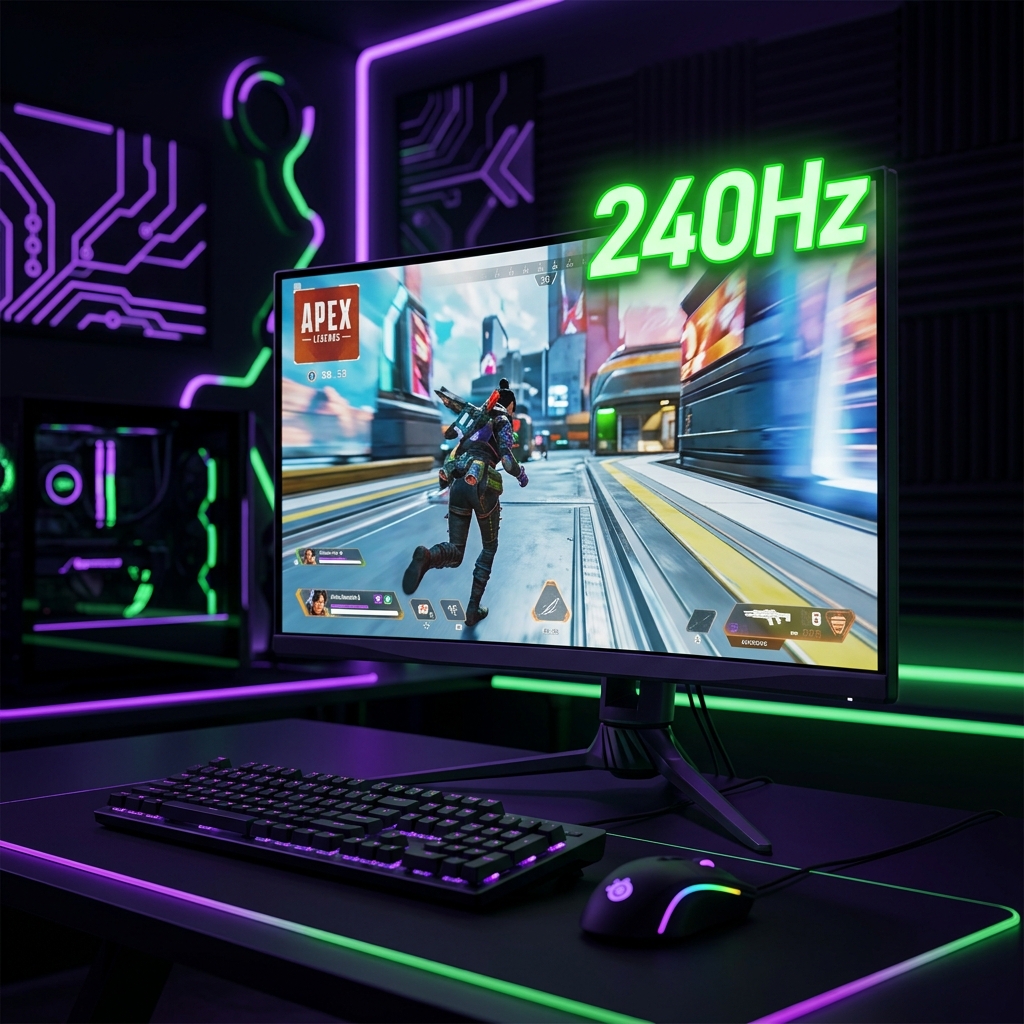
The Competitive Edge: Refresh Rates in Gaming
When analyzing the profound impact of "Monitor with High Refresh Rate: Buying Guide for Beginners", it becomes immediately clear why esports professionals refuse to settle for anything less than top-tier visual performance. In the realm of competitive gaming, where matches are won and lost in fractions of a second, the frequency at which your monitor updates its image dictates your ability to react to sudden threats. A standard 60Hz monitor updates its image every 16.67 milliseconds. While this was completely acceptable a decade ago, modern twitch-shooters like Valorant, Counter-Strike 2, and Apex Legends demand far greater speed. By upgrading to a 144Hz or 240Hz panel, that frame time plummets to 6.94ms and 4.16ms, respectively.
The mathematical reduction in frame time might sound small on paper, but the visual reality is staggering. It decreases the perceived input lag between your mouse movement and the corresponding on-screen action. Moreover, it drastically minimizes motion blur and ghosting, allowing you to clearly track enemies as they strafe rapidly across your field of view. This fundamental concept is central to understanding why high-refresh-rate gaming has transitioned from an expensive luxury to an absolute necessity for anyone looking to climb the competitive ranking ladders.
60Hz vs 144Hz vs 240Hz: What It Really Means
To fully grasp the implications of "Monitor with High Refresh Rate: Buying Guide for Beginners", we must break down the specific tiers of gaming monitors available on the market today. The leap from 60Hz to 144Hz is universally considered the most dramatic and life-changing upgrade a PC gamer can experience. The jump in fluidity is instantly recognizable, making the environment feel alive and deeply responsive. The "judder" common in fast panning motions on 60Hz displays vanishes, replaced by a smooth cinematic glide that dramatically improves target acquisition and tracking accuracy.
On the other hand, the jump from 144Hz to 240Hz (or even 360Hz) provides a case of diminishing returns. Make no mistake, 240Hz is tangibly smoother than 144Hz, but the magnitude of the difference is much smaller. Only highly competitive gamers with incredibly fast innate reaction times will physically benefit from the milliseconds shaved off the frame interval at these extreme speeds. For the average casual gamer exploring vast open-world RPGs, investing heavy capital into a 240Hz display might be misplaced, as achieving 240 frames per second in graphically demanding titles requires a monolithic graphics card like the NVIDIA RTX 4090.
Finding the Sweet Spot for Your Hardware
As you navigate the concepts covered in "Monitor with High Refresh Rate: Buying Guide for Beginners", keep in mind that hardware synergy is the ultimate goal. A high refresh rate monitor is only as good as the GPU driving it. If your system is prone to massive frame rate dips during intense firefights, you will experience a jarring phenomenon known as screen tearing. To combat this, modern gaming monitors integrate adaptive sync technologies like NVIDIA G-Sync and AMD FreeSync. These elegant, hardware-level solutions force the monitor to dynamically adjust its refresh rate on the fly to perfectly match the fluctuating output of your graphics card, ensuring a tear-free and stutter-free experience regardless of how chaotic the gameplay gets.
Beyond adaptive sync, gamers must also consider the panel technology itself. Fast IPS panels have largely replaced older TN panels, offering the perfect hybrid of vibrant, accurate colors and blazing-fast 1ms response times. OLED monitors are now entering the mainstream, providing near-instantaneous pixel response times (0.03ms) that make even a 120Hz OLED feel dramatically smoother than a 240Hz LCD display. Understanding how panel type intersects with refresh rate is vital when pinpointing the ultimate gaming setup.
The Final Verdict: Mandatory or Marketing Hype?
So, addressing the core premise of "Monitor with High Refresh Rate: Buying Guide for Beginners", is a high refresh rate completely mandatory? For pure competitive integrity, the answer is an unequivocal yes. It removes the mechanical bottleneck imposed by slow hardware, allowing your personal skills and reflexes to dictate the outcome of an engagement. For casual players heavily invested in narrative-driven, visually stunning single-player epics, it is highly recommended but not strictly mandatory. However, once you have experienced the sublime fluidity of high-refresh-rate gaming, going back to 60Hz feels akin to wading through molasses. It is an evolutionary leap in interactive media that redefines visual expectations.